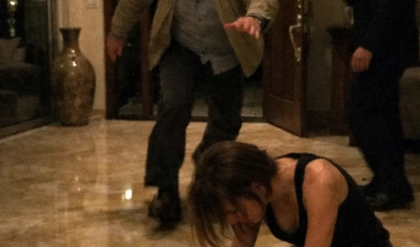
The Son Tried to Take His Parents’ House Using Forged Papers and a Confident Smile — “It’s Already Been Transferred, You Just Don’t Understand the Process,” He Insisted While Forcing His Mother Out, But the Moment His Father Calmly Revealed the Property Had Been Legally Placed in Her Name Months Earlier, Everything He Planned Collapsed in Complete Silence
There is a particular kind of silence that settles over a room when something has gone so far past misunderstanding that it begins to feel like revelation, and I remember that exact silence sitting in my chest the night my own son stood in my kitchen with papers in his hand and a confidence in his voice that did not belong to truth, while my wife stood outside our gate with a single grocery bag as if the life we had built together could be reduced to something you carry in one arm.
My name is Victor Armand, I am sixty-four years old, and I have spent most of my life believing that if you built something carefully enough, honestly enough, with your own hands and your own time, it would stand not only against weather but against people as well, which turned out to be the kind of belief that only gets tested when it matters most.
The house on Cedar Hollow Drive was never just a house to me, even though anyone passing by would have seen only a modest two-story place with a wraparound porch and a maple tree that dropped too many leaves every fall, because inside those walls lived every version of my life that had ever mattered, from the early years when my wife Elaine and I counted coins to buy groceries to the years when our son Garrett ran through the halls with scraped knees and endless questions about everything I was fixing in the garage.
Elaine had chosen the pale blue siding after weeks of debating colors, insisting that if she was going to wake up and look at something every morning it had better feel like peace instead of compromise, and I had built the back deck myself one summer when money was tight but determination wasn’t, measuring each plank twice and sanding every edge until it felt like something worth standing on.
Home, I used to think, was a structure.
Later I learned it was a promise.
And promises, unlike wood or stone, can be broken from the inside.
The afternoon I found Elaine at the gate, her coat misbuttoned and her hands trembling just enough to tell me something was very wrong, I felt that quiet internal shift that comes before anger, before words, before anything you can name, because there are moments when your body understands betrayal before your mind is willing to accept it.
“Victor,” she said, her voice thinner than I had ever heard it, “Garrett was here. He brought someone with him. They said… they said things I didn’t understand.”
I picked up the grocery bag first, not because it mattered but because it was something I could control, and then I took her hand, which felt colder than it should have in the mild October air.
“What kind of things?” I asked.
She swallowed, her eyes searching mine as if asking permission to say it out loud.
“They said the house isn’t ours anymore.”
It is a strange thing, hearing a sentence that is both absurd and dangerous at the same time, because part of you wants to laugh at how impossible it sounds while another part already knows that someone has gone to great lengths to make it sound believable.
I walked into my own house with a calm that did not come from peace but from experience, because I have learned over decades that the louder a lie tries to sound, the quieter the truth needs to be when it answers.
Garrett was in the kitchen, leaning against the counter like he belonged there in a way that felt different from before, and beside him stood a man I recognized from a handful of dinners and too many polished conversations, a man named Julian Reeves, whose profession in property consulting had always seemed harmless until that moment.
“Dad,” Garrett said, straightening as if rehearsed, “we need to talk.”
There is a tone adult children use when they believe they have already won an argument that hasn’t happened yet, and it is one of the most revealing sounds in the world.
“I imagine we do,” I replied, setting the grocery bag on the table and taking off my jacket slowly, deliberately, the way you do when you intend to stay for whatever comes next.

Julian stepped forward slightly, his smile professional, controlled.
“Mr. Armand, I know this is unexpected, but Garrett and I have been working on a long-term estate transition plan that—”
I raised a hand, not sharply but firmly enough to stop him.
“You can call me Victor,” I said. “And you can also explain why my wife was just told to leave her own home.”
Garrett exhaled, running a hand through his hair in a gesture I recognized from his childhood, except now it was paired with something new, something practiced.
“It’s not like that,” he said. “We’re just trying to get ahead of things. The market is high right now, and legally, with the documents we’ve put together, it makes more sense for the property to be transferred early, before complications—”
“Transferred to whom?” I asked, though I already suspected the answer.
He hesitated for half a second, and in that half-second I saw the boy he had been and the man he was trying to become colliding in a way that left no room for honesty.
“To me,” he said finally.
“And Joel—” he corrected himself quickly, “and Julian’s firm would manage the process.”
Julian nodded as if confirming something respectable.
“It’s a very common strategy,” he added. “Protects the asset, minimizes tax exposure, ensures continuity.”
There are many ways to lie, but the most effective ones are dressed in language that sounds reasonable.
I walked past them to the drawer by the sink, opened it, and took out a folded envelope that had been sitting there for weeks, untouched but not forgotten.
“Before we continue,” I said, turning back toward them, “I think we should all be very clear about what is real and what is not.”
Garrett frowned slightly, his confidence flickering.
“What do you mean?”
I placed the envelope on the table and slid it toward him.
“Open it.”
He looked at Julian, who gave a small, encouraging nod, the kind that says proceed without actually taking responsibility.
Garrett opened the envelope, pulled out the papers inside, and as his eyes moved across the first page, something in his expression shifted in a way that no amount of training could hide.
“What is this?” he asked, his voice tighter now.
“That,” I said calmly, “is the official record of ownership for this property, updated six months ago.”
Julian leaned in, his composure cracking just slightly as he read over Garrett’s shoulder.
“That’s not possible,” he said. “We checked the registry. It was still in your name.”
“It was,” I agreed. “Until March.”
Garrett looked up at me, confusion and something else—something closer to fear—beginning to surface.
“Then whose name is it in now?”
I let the question sit for a moment, not out of cruelty but because some truths need space before they land.
“My wife’s,” I said. “Entirely. Legally. Irrevocably.”
The kitchen went very still.
Julian’s professional calm evaporated first, replaced by a sharp calculation that told me he was already trying to figure out how this affected him.
“That doesn’t make sense,” he said quickly. “Any transfer like that would have required—”
“My signature,” I finished for him. “Which I provided. In person. With witnesses. After reviewing every detail with an attorney who does not appreciate shortcuts.”
Garrett’s face had gone pale in a way I had not seen since he was a child caught in a lie he could not talk his way out of.
“You never told me,” he said.
“You never asked,” I replied.
That is the thing about assumptions—they feel like knowledge until they collide with reality.
Julian straightened, his tone shifting from confident to defensive.
“There must be some misunderstanding,” he said. “Because the documents Garrett showed Elaine clearly indicate—”
“Forgery,” I said quietly, and the word landed heavier than anything else in the room.
Garrett shook his head immediately.
“No, that’s not—”
“It is,” I interrupted, not raising my voice but letting the certainty in it do the work. “And I would advise you to choose your next words carefully, because what happens next depends very much on whether you understand the difference between a mistake and a deliberate act.”
Silence stretched between us, thick and unavoidable.
Elaine stepped into the doorway behind me then, her presence steadying something in the room that had been off balance.
“This is our home,” she said softly, not as a challenge but as a statement of fact. “We built it together.”
Garrett looked at her, and for a moment I saw something like regret flicker across his face, but it was buried quickly under the weight of everything he had already set in motion.
“I was just trying to help,” he said, though even he did not seem convinced by the words anymore.
“Help who?” I asked.
He didn’t answer.
Julian did.
“The intention was to streamline ownership,” he said, though his voice lacked the earlier confidence. “These things can get complicated—”
“They already have,” I said. “And they will get much more so if we involve the authorities, which is exactly what I am prepared to do.”
That was when the balance shifted completely.
Garrett’s shoulders dropped slightly, the fight leaving him in a way that felt less like defeat and more like realization.
“You’d really do that?” he asked, his voice quieter now.
I looked at him for a long moment, seeing not just the man in front of me but every version of him that had come before.
“I would protect your mother,” I said. “Always.”
Julian stepped back then, the calculation in his eyes replaced by something closer to caution.
“I think it might be best if we… reassess,” he said, already distancing himself from the situation he had helped create.
“That would be wise,” I replied.
He left first, his exit quick and controlled, the way people leave when they know they have crossed a line they cannot defend.
Garrett stayed.
For a long time, none of us spoke.
Then he sat down at the kitchen table, the same table where he had done homework and argued about curfews and once spilled an entire carton of milk while trying to prove he could carry too much at once.
“I didn’t think it would go this far,” he said finally.
“That’s the problem with lines,” I said. “You don’t always see them until you’re on the wrong side of them.”
He nodded slowly, his hands clasped together in front of him.
“I was under pressure,” he admitted. “Debt. Bad decisions. I thought if I could just secure the house, everything else would work itself out.”
“By taking something that wasn’t yours,” Elaine said gently.
He flinched at that, more than he had at anything I had said.
“I know,” he whispered.
The road back from a mistake like that is not quick, and it is not easy, but it exists for those willing to walk it.
We did not call the police that night.
Not because what he had done did not deserve consequences, but because sometimes the most meaningful consequences are the ones that force a person to face what they have become and decide whether they are willing to change it.
Garrett spent the next months doing exactly that.
He cut ties with Julian’s firm, reported the falsified documents himself, and worked to repair the damage he had caused not just legally but personally, which turned out to be the harder task.
Trust, once broken, does not return because someone asks it to.
It returns slowly, in small moments, through actions that speak louder than any explanation.
Elaine forgave him first.
Not quickly, not easily, but completely, because that is who she has always been.
I followed, in my own time, because being a father means understanding that love does not end where disappointment begins.
The house on Cedar Hollow still stands, blue siding and all, the maple tree still dropping too many leaves every fall, the porch still holding the weight of everything we have been through together.
And sometimes, when I sit there in the quiet of the evening, I think about that day at the gate, about the grocery bag and the papers and the silence that followed, and I realize something I did not fully understand before.
Home is not just what you build.
It is what you protect.
And sometimes, protecting it means standing firm long enough for the people you love to find their way back to it, even after they have tried to walk away.