The Funeral Was Meant to Be Private Until a Boy in a Worn Hoodie Stepped Forward Beside the Casket — “He Said If He Died… You Would Take Me,” He Whispered, But the Moment She Read the Six Words Written on the Back of the Card, the Woman Who Controlled Everything Realized the Truth She Buried Was Standing Right in Front of Her
The silence in the funeral room wasn’t peaceful, not the kind that comforts or softens anything, but the kind that presses down on your chest and makes even the smallest movement feel like an interruption you’re not supposed to make, as if grief itself had taken on a shape and settled into every corner of the space, watching, waiting, measuring who belonged there and who didn’t.
White flowers framed the room in careful symmetry, their scent sharp and clean, competing with the polish of dark wood and the faint trace of perfume from people who had dressed for mourning the way they dressed for everything else—deliberately, elegantly, with control.
At the center of it all lay the man everyone had come to say goodbye to.
Arthur Bennett.
Impeccably dressed even in stillness, his hands folded with the kind of precision that suggested someone else had arranged them that way, his expression calm in a way that felt almost rehearsed, like the final version of a life that had been edited for public memory.
Around him, conversations murmured in low tones, voices softened not by sorrow alone but by expectation, by the understanding that this was a place where emotions were meant to be contained, displayed only in acceptable ways.
That was why the boy stood out immediately.
He didn’t belong to that version of grief.
He stood near the casket, small and unmoving, his oversized dark hoodie hanging loosely from his shoulders, the fabric worn thin at the edges, his shoes scuffed enough to tell a story of miles walked rather than places driven to, and there was dirt along his sleeves and on his hands, not fresh but settled, like something that had been part of him for longer than it should have been.
No one had brought him there.
No one stood behind him, guiding him, explaining him, claiming him.
He was simply there.
And beside him stood Eleanor Pierce.
She had arrived early, as she always did, moving through the room with the quiet authority of someone who had spent decades shaping spaces like this, ensuring that nothing slipped out of place, that appearances remained intact even when reality threatened to disrupt them.
Her black blazer was tailored perfectly, her silver hair pinned back with precision, and the necklace at her throat caught the light just enough to remind anyone looking that she belonged to a world where details mattered.
At first, she barely noticed the boy.
He was just another irregularity in a room that had already been arranged to ignore irregularities.
But then he spoke.
“He said if he died… you would take me.”
The words didn’t carry far.
They didn’t need to.
They landed directly where they were meant to.
Eleanor turned sharply, the controlled composure she wore so effortlessly slipping for just a fraction of a second before she caught it again, her gaze settling on the boy with a mixture of confusion and something closer to resistance.
“Take care of you?” she repeated, her voice low, careful, as if repeating it might change what it meant.
The boy nodded once.
There were no tears now.
No visible panic.
Just a quiet certainty that didn’t match his age.

Eleanor looked at him more closely then, her eyes narrowing slightly as she took in the details she had initially dismissed, the shape of his face, the line of his jaw, the way his eyes held steady even under her scrutiny.
Something about him felt… familiar.
Not in a way she could immediately name, but enough to unsettle the careful balance she had maintained for years.
“Who are you?” she asked, her voice softer now, but edged with something that suggested she wasn’t entirely sure she wanted the answer.
The boy didn’t respond right away.
Instead, he turned his head slightly, looking at the man in the casket as if drawing strength from the stillness there, from a presence that could no longer speak but had clearly said enough when it mattered.
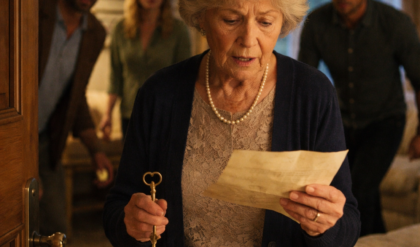
Then he reached into the pocket of his hoodie and pulled out a folded funeral card, the paper creased and worn, as if it had been carried for days, maybe longer.
He held it out to her.
Eleanor hesitated.
Then took it.
Her fingers brushed against the paper, and for a moment nothing happened, as if the world itself paused to give her the chance to step back, to refuse whatever was about to unfold.
But she opened it.
And on the back, written in uneven handwriting that she recognized instantly, were six words.
Give him the watch she hid.
The room seemed to shift.
Not visibly.
Not to anyone else.
But inside her, something gave way.
Her grip tightened on the card.
Her breath caught.
Because there was only one watch.
Only one secret she had carried for longer than she cared to admit.
And only one reason it would matter now.
The boy watched her carefully.
“He said you know who I am,” he added, his voice barely above a whisper.
Eleanor closed the card slowly, her mind moving through years of memory faster than she could process them, pulling threads she had tied off long ago, threads she had convinced herself no longer connected to anything real.
“That’s not possible,” she said quietly, though the words lacked conviction.
The boy didn’t argue.
Didn’t push.
He simply stood there, waiting in the same way he had when he first spoke, as if he understood that whatever needed to happen now couldn’t be rushed.
Eleanor turned away from him, her gaze falling back to Arthur’s still face, and for the first time since she had entered the room, the carefully constructed version of the man she had allowed herself to remember began to fracture.
“You promised me,” she murmured under her breath, the words meant for someone who could no longer respond. “You said this was done.”
But promises, she knew, had a way of unraveling when they were built on silence.
A voice interrupted her thoughts.
“Everything alright, Ms. Pierce?”
It was Gregory Shaw, Arthur’s business partner, his presence as polished as always, his tone measured, but his eyes sharp with curiosity that he didn’t bother to hide completely.
Eleanor straightened slightly, instinctively pulling her composure back into place.
“Fine,” she said.
Gregory’s gaze shifted to the boy.
“And who is this?” he asked, though something in his expression suggested he already saw him as a problem rather than a person.
“No one,” Eleanor replied quickly, too quickly.
The boy flinched, just slightly.
It was small.
But it was there.
And something in Eleanor’s chest tightened in response.
Gregory smiled thinly.
“If he’s not family, he shouldn’t be here,” he said. “This is a private service.”
The words were polite.
The meaning wasn’t.
Eleanor glanced at the boy again, and in that moment, the choice in front of her became painfully clear, not because it was complicated, but because it was simple in a way that forced her to confront everything she had avoided.
“Wait outside,” she told the boy, her voice softer now.
He hesitated.
Then nodded.
And walked away without another word.
Gregory watched him go, then turned back to Eleanor.
“You’ve done enough for Arthur,” he said quietly. “There’s no need to involve yourself in… complications.”
Eleanor didn’t respond.
Because for the first time, she was beginning to understand that the complication wasn’t new.
It had always been there.
She just hadn’t allowed herself to see it.
The watch was in a safe.
Locked.
Hidden.
Exactly where she had left it years ago, believing that by keeping it out of sight, she had also kept everything connected to it from resurfacing.
It was gold, understated but unmistakably valuable, engraved on the back with a date and a name she had chosen not to acknowledge.
When she opened the safe and held it again, the weight of it felt different, heavier somehow, not because it had changed, but because she had.
She stared at the engraving.
Then closed her eyes briefly.
“You should have told me,” she whispered, though whether she meant Arthur or herself, she couldn’t say.
When she returned, the boy was still there, sitting quietly on a bench outside the funeral home, his hands folded in his lap, his posture patient in a way that didn’t belong to someone his age.
Eleanor approached slowly.
He looked up.
She held out the watch.
His eyes widened slightly.
“He said you’d give it to me,” he said.
Eleanor nodded.
“And he said why?” she asked.
The boy hesitated.
Then shook his head.
Eleanor crouched down in front of him, bringing herself to his level, something she rarely did for anyone.
“Because it belongs to you,” she said. “Because you are his son.”
The words felt strange.
Heavy.
But once spoken, they settled into place with a certainty she couldn’t deny.
The boy didn’t react immediately.
Then, slowly, he reached out and took the watch, holding it carefully, as if it carried more than just metal and memory.
“My name is Jacob,” he said quietly.
Eleanor nodded.
“I know,” she replied, though she had only just learned it.
Behind them, Gregory had stepped outside, his expression darkening as he took in the scene.
“This is unacceptable,” he said sharply. “You can’t just—”
Eleanor stood, turning to face him fully.
“For years,” she said, her voice steady now, stronger than it had been inside, “you’ve managed Arthur’s affairs, his image, his legacy.”
Gregory straightened, sensing the shift.
“And I’ve done it well,” he replied.
“You’ve done it conveniently,” Eleanor corrected. “For yourself.”
He frowned.
“What are you implying?”
Eleanor held his gaze.
“I’m saying that you knew,” she said. “About him. About Jacob. And you chose to ignore it because it complicated your version of things.”
Gregory’s expression hardened.
“That’s a serious accusation.”
“And a true one,” she said.
There was a pause.
Then Eleanor reached into her bag and pulled out the folder she had taken from Arthur’s office months earlier but never opened fully.
Inside were documents.
Letters.
Evidence.
All of it pointing to the same truth.
Arthur had tried to provide for Jacob quietly.
And Gregory had blocked it.
Redirected it.
Buried it.
“You wanted control,” Eleanor said. “And you thought no one would ever question it.”
Gregory didn’t respond.
Because there was nothing he could say that would undo what had just been revealed.
In the days that followed, the story unraveled publicly, not in whispers but in clear, undeniable facts, and the consequences were swift and irreversible.
Gregory lost everything he had built on that deception.
And Jacob gained what had always been his, not just financially, but in acknowledgment, in identity, in the simple but powerful truth of being seen.
Eleanor changed too.
Not dramatically.
Not in ways that drew attention.
But in the quiet choices that followed.
She brought Jacob home.
Not out of obligation.
But because it was right.
And for the first time in years, the silence in her life felt different, not heavy and controlled, but open, like something new had finally been allowed to begin.