The Biker Sla:pped a Man’s Wrist in the Middle of a Quiet Grocery Store — “That’s Not Your Kid,” He Said, as the Crowd Turned on Him, But the Moment a Stranger Picked Up the Silver Clasp He Dropped and Read the Three Engraved Words, the Entire Room Fell Silent and Everything Changed
There are moments that begin so ordinarily your mind doesn’t even bother to mark them as important, the kind of small, forgettable slices of a weekday that dissolve into routine before you’ve had the chance to question them—and then, without warning, something shifts, something breaks that invisible line between normal and unforgettable, and suddenly you’re standing inside a story you will spend years trying to explain to people who weren’t there.
It was one of those afternoons.
A Tuesday, just past three, inside a grocery store that smelled faintly of overripe bananas and floor cleaner, where fluorescent lights hummed quietly overhead and the checkout lines moved with the slow patience of people who had nowhere else urgent to be. The kind of place where strangers stood shoulder to shoulder without ever truly seeing each other, each person wrapped in their own calculations—prices, lists, worries, time.
Clara Whitfield stood in line with a half-full cart and a folded envelope of cash tucked carefully in her coat pocket, mentally subtracting each item before it reached the scanner, her lips moving faintly as she counted, recalculated, and adjusted, hoping—quietly, stubbornly—that she wouldn’t have to put anything back.
She noticed the baby before she noticed anything else.
Not because the baby made noise.
But because she didn’t.
The little girl couldn’t have been older than six months, wrapped in a pale yellow blanket that looked too thin for the season, her face turned slightly inward, her eyes open but distant in a way that didn’t match the usual restless curiosity of infants. She lay in the arms of a man standing two places ahead in line, his posture relaxed, his expression neutral enough to disappear into a crowd, the kind of face you wouldn’t remember five minutes later.
There was nothing immediately wrong.
And yet.
Clara found herself looking again.
The man adjusted his hold on the baby, just a fraction too quickly, his fingers tightening briefly around the sleeve of her tiny jacket before relaxing again, and though it was subtle—so subtle most people would never register it—it left behind a small, persistent discomfort, like a word you couldn’t quite recall but knew mattered.
Then the door chimed.
And everything changed.
He didn’t belong to the room in the way that made people step back without realizing they had done it.
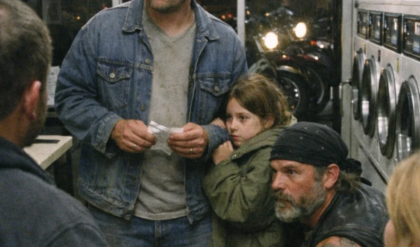
Tall. Broad across the shoulders. A gray beard that had grown in uneven along the jawline. A worn leather vest layered over a dark shirt, tattoos curling along his forearms like stories written in a language no one asked to read. His boots struck the tile floor with a deliberate heaviness, each step landing with the kind of quiet authority that didn’t need to announce itself.
Conversations faltered.
Eyes lifted.
And judgments formed instantly, automatically, without permission.
The biker didn’t pick up a basket.
Didn’t reach for a cart.
He simply walked in and stopped.
And watched.
At first, Clara thought it was just curiosity, the kind people sometimes feel when they enter a space they don’t usually occupy, but there was something else in the way his gaze moved—not across the shelves, not toward the checkout counters, but directly, steadily, toward the man holding the baby.
It wasn’t casual.
It wasn’t wandering.
It was focused.
Intent.
The kind of looking that suggested he had already decided something and was now confirming it.
Clara felt it before she understood it.
That quiet shift.
That almost imperceptible tightening of the air.
The baby moved.
Just slightly.
A small, uneven motion that broke her stillness, and the man holding her reacted immediately, adjusting his grip again, too quickly, too firmly, his hand closing around her arm in a way that made Clara’s stomach tighten.
The biker stepped forward.
No hesitation.
No announcement.
Just movement.
And then—
It happened.
Fast enough that no one had time to prepare for it.
His hand came out sharply, striking the man’s wrist with a clean, precise motion that echoed through the store like a crack, sudden and impossible to ignore.
The baby cried.
A sharp, startled sound that cut through everything.
Gasps followed.
A woman near the candy rack dropped her basket.
“What the hell are you doing?!” someone shouted, voice rising with instant outrage.
The man staggered back, clutching the baby closer, his face twisting with shock and anger as he looked at the biker like he had just been attacked without reason, without warning, without any justification that made sense to the watching crowd.
“This is my daughter!” he snapped, his voice tight, controlled, rehearsed. “Stay away from us!”
The room turned.
Not physically.
But emotionally.
Instantly.
Because in that moment, every instinct in that store aligned against the same target.

The biker.
The stranger.
The threat.
Clara felt it too—that pull, that immediate, almost automatic judgment—but something held her back, something quiet and stubborn that refused to settle into the obvious conclusion.
Because something wasn’t finished yet.
Something had fallen.
It landed near her feet with a soft, almost insignificant sound.
She didn’t even realize she was moving until she was already bending down, her fingers hovering for a brief second before closing around the object resting against the tile floor.
It was small.
Light.
And cold.
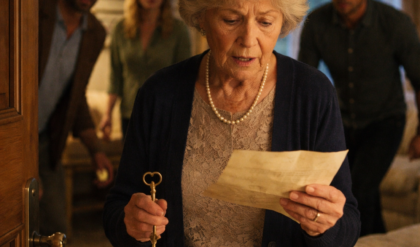
A silver clasp.
Attached to a thin cord.
At first glance, it looked like nothing more than a cheap accessory, the kind you might overlook entirely.
Then she turned it over.
And saw the engraving.
Her breath caught.
Not because she immediately understood what it meant.
But because of the way the biker was looking at her.
Not at the man.
Not at the baby.
At her.
His eyes locked onto the object in her hand with a sharp, unmistakable intensity.
“Read it,” he said quietly.
The words weren’t loud.
But they carried.
Clara hesitated, her pulse quickening as the attention of the room shifted toward her, toward the small thing she now held, toward the moment that hadn’t resolved itself the way everyone expected.
“What is that?” someone asked.
The man’s voice came fast, too fast.
“Just give it back,” he said, reaching out, his tone suddenly edged with something tighter, less controlled. “It’s nothing. Just give it back.”
Clara pulled her hand back instinctively.
And read.
Three words.
Carefully engraved.
Too deliberate to be meaningless.
Too specific to be ignored.
Not Yours Child.
The air changed.
Not loudly.
Not dramatically.
But unmistakably.
Clara looked up slowly, her eyes moving from the engraving to the man holding the baby, and for the first time, she really saw him—not the calm exterior, not the controlled posture, but the small cracks beneath it, the tension in his jaw, the flicker of something defensive, something calculating.
“What is this?” she asked, her voice quieter than she expected, but steady.
The man laughed.
Too quickly.
Too sharply.
“It’s a joke,” he said. “Something stupid. Give it back.”
But the baby—
The baby didn’t react to his voice.
Didn’t turn toward him.
Didn’t settle against him the way children instinctively do.
Instead, her eyes—those quiet, distant eyes—shifted slightly.
Toward the biker.
And in that small, almost invisible movement, something inside Clara clicked into place.
The biker stepped forward again, slower this time, his voice lower, controlled in a way that suggested effort rather than ease.
“You’re holding her wrong,” he said.
The man’s expression hardened.
“I said stay back.”
“That’s not your kid,” the biker replied.
Silence.
Heavy.
Immediate.
The kind that presses against your chest before your mind has time to process it.
“You don’t get to say that,” the man snapped, his voice rising, cracks beginning to show. “You don’t know anything—”
“I know enough,” the biker interrupted, his gaze unwavering. “And you dropped the one thing you shouldn’t have.”
Clara held the clasp tighter without realizing it.
“Where did you get this?” she asked, her voice firmer now.
The man didn’t answer.
Because in that moment, he understood what everyone else was just beginning to realize.
This wasn’t random.
This wasn’t a misunderstanding.
And whatever story he had been relying on…
Was unraveling.
The store manager appeared near the counter, uncertain, caught between stepping in and stepping back, while a few customers had already pulled out their phones, the scene unfolding too quickly, too strangely to ignore.
“Sir,” the manager began cautiously, addressing the biker, “you can’t just—”
“Call the police,” the biker said, not taking his eyes off the man. “Now.”
The authority in his voice didn’t sound like a request.
It sounded like someone who had already seen how this ended.
The man shifted his weight.
Just slightly.
Just enough.
And the biker saw it.
“Don’t,” he said.
But the man moved anyway.
Turning sharply, trying to push past the line, clutching the baby tighter as if speed alone could carry him out of the situation, out of the room, out of the consequences closing in around him.
He didn’t get far.
Two customers stepped instinctively into his path, hesitation overridden by something stronger now—doubt, concern, the growing realization that this was no longer a clear-cut story with an obvious villain.
The baby cried again.
Louder this time.
And in that sound, something broke.
Not in the room.
In the man.
Because for the first time, he hesitated.
And hesitation was enough.
The biker closed the distance in two long strides, not aggressive, not reckless, but precise, controlled, his hand reaching out—not to strike this time, but to steady the baby, to take her carefully, firmly, from arms that no longer held her with certainty.
The man didn’t fight.
Not really.
Because the room had already turned.
Not against the biker.
Against him.
Sirens sounded faintly in the distance, growing louder with each passing second, and by the time they arrived, the truth had already settled into the space between everyone present, heavy and undeniable.
The clasp.
The engraving.
The way the baby responded.
The way the man couldn’t answer the simplest questions without slipping.
Later, Clara would learn the rest.
That the biker—his name was Raymond Griggs—had spent years working with a volunteer network that helped locate missing children, that he recognized the clasp immediately because he had seen its match before, that it belonged to a case that had never been closed, a child taken without witnesses, without noise, without answers.
That he hadn’t come into the store by accident.
That he had been looking.
And that he had finally found her.
The man’s story unraveled completely under questioning, each inconsistency peeling away until there was nothing left to hold it together, nothing left to protect him from the consequences he had tried to outrun.
And the baby—
She wasn’t his.
She never had been.
Weeks later, Clara stood outside a small house at the edge of town, watching as a woman knelt on the porch, her hands trembling as she reached out, her face breaking open with a kind of relief that didn’t need words to be understood.
Raymond stood a few steps back, quiet, still, as if the moment didn’t belong to him even though he had carried it into existence.
Clara walked over slowly.
“You knew,” she said softly.
He shook his head.
“I hoped,” he replied. “That’s different.”
She looked at him, at the man everyone in that store had judged in a single glance and been so certain about.
“You saved her.”
He shrugged slightly, his gaze drifting toward the house, toward the reunion unfolding in quiet, fragile pieces.
“I just paid attention,” he said.
And for a moment, that felt like the most important thing anyone had said in a long time.
Because sometimes, the difference between harm and safety isn’t strength, or noise, or certainty.
It’s the willingness to look twice when everyone else looks away.
And that day, in a grocery store where nothing was supposed to happen, one man did exactly that—and because he did, a child went home, a lie collapsed, and the truth, quiet as it had been all along, was finally heard.