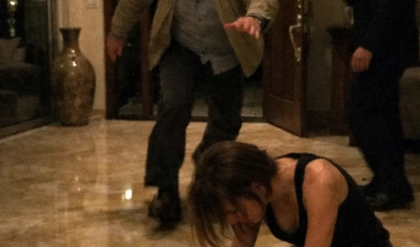
The Retired Judge Heard His Son Planning to Declare Him Mentally Unfit Over Dinner — “He Just Has to Look Like He’s Losing Control,” the Daughter-in-Law Whispered, But the Moment He Invited Them to a ‘Family Meeting’ with Lawyers and Slid the Folder Across the Table, Everything They Thought They Had Planned Fell Apart
There are moments when your life doesn’t break with a loud sound or a dramatic collapse, but instead shifts quietly beneath your feet, like a porch board giving way just enough to warn you that the structure you trusted has already begun to fail—and by the time you realize it, you’re no longer standing where you thought you were.
The text from my son came while I was idling at a red light on Interstate 89, the late afternoon sky dimming into that cold, bluish gray that settles over Vermont in November like a quiet decision no one argues with.
Dad, we made dinner. Come straight home. We want to hear everything.
I remember reading it twice, not because I didn’t understand it, but because I wanted to feel it properly—the warmth behind the words, the expectation, the simple kind of family moment that had become rarer over the years without either of us saying so out loud.
I smiled, though it was not the kind of smile anyone else would have noticed. It was the private kind, the kind a man allows himself when he has carried responsibility for long enough that even the possibility of relief feels like something delicate, something that might vanish if acknowledged too loudly.
Three months earlier, my son—his name was Ryan—and his wife, Laura, had moved into my house after their landscaping business folded under a weight of debt that seemed to change shape every time we tried to understand it. Equipment leases, vendor payments, legal notices—each week brought a new explanation, each explanation came with a new layer of quiet embarrassment that Ryan tried to hide behind optimism and Laura tried to control through planning.
I had stopped asking for details.
There is a point at which a father understands that offering help matters more than understanding every failure that led to the need for it.
So when the attorney in Burlington told me that my sister had left me an estate worth just over four million dollars, my first thought had not been about myself.
It had been about repair.
About second chances.
About the possibility that the story my son was living might not end where it seemed to be heading.
By the time I turned onto my road outside Montpelier, the light had fully drained from the sky, leaving the world lit only by porch lamps and windows, small squares of warmth pressed against the dark. My house stood where it always had, an aging white colonial with a front porch that had needed repainting for years and boards that remembered every winter they had survived.
The dining room window glowed.
And through it, I saw them.
Ryan and Laura sat close together at the table, leaning in, their bodies angled in a way that suggested urgency rather than comfort. Their movements were quick, their conversation intense, and though I could not hear the words from the driveway, I recognized the posture immediately.
Thirty years on the federal bench had taught me something that never quite leaves you.
People reveal themselves long before they realize they have.
I turned off the engine but didn’t get out right away.
Instead, I sat in the dark, watching.
Not suspicious yet.
But attentive.
Then I stepped out of the car quietly and moved toward the porch, my shoes finding the familiar path without needing light. The second board always creaked—I stepped over it out of habit, something my body remembered even when my mind was elsewhere.
The window was open a crack.
And then—
I heard my name.
Not spoken.
Discussed.
“…it’s more than we thought,” Ryan was saying, his voice lower than usual, controlled but not steady. “The lawyer said over four million. Everything goes to him.”
There is a strange quality to hearing yourself referred to as him inside your own home.
It separates you from your own life in a way that feels almost physical.
Laura answered quickly, her tone sharper, more precise.
“That’s exactly why we can’t wait,” she said. “He doesn’t know we know. That’s the only advantage we have.”
Advantage.
The word settled into me before the meaning did.
Ryan said something quieter, something I couldn’t fully catch.
Laura didn’t lower her voice.
“Listen to me,” she continued, leaning closer. “If he moves the money first, we lose control. We have to act before that happens. Dr. Kessler already agreed to review the case. You told him about the memory lapses, right?”

My breath slowed.
Not from calm.
From discipline.
“I told him Dad forgets things sometimes,” Ryan said, his voice uncertain. “But that’s not the same as—”
“It doesn’t have to be,” Laura cut in. “He doesn’t have to be incompetent. He just has to look like he might be. We file for temporary guardianship. That gives us control of the accounts. After that, it’s just paperwork.”
Silence followed.
Long enough that I almost stepped away.
Then Ryan spoke again.
Quiet.
Careful.
“He’s not losing his mind.”
Laura laughed softly.
Not amused.
Not kind.
“He doesn’t have to,” she said. “He just has to lose control.”
I stepped back from the window.
Not because I needed distance.
But because something inside me required space to remain intact.
The cold air met my face, sharp and immediate, grounding in a way that emotion never is. For a brief, absurd moment, I noticed the mailbox at the end of the driveway and thought I should check it before going inside, as if routine might anchor me to a version of reality that had just been quietly dismantled.
I walked to the far end of the porch and placed one hand on the railing.
Breathed in.
Slowly.
Breathed out.
Emotion is information.
Not instruction.
It was something I had learned early in my career, though it had taken decades to understand fully. You feel what you feel, you acknowledge it, but you do not act until you understand what it means.
Inside, my son and his wife were discussing how to take control of my mind, my home, and the last gift my sister had left me.
I stood there for nearly five minutes.
Then I opened the door.
The warmth hit me immediately, carrying with it the smell of baked cheese and tomato sauce, something familiar, something domestic, something that might have belonged to a different version of this evening.
“Something smells good,” I said, stepping inside.
Ryan looked up and smiled.
“Lasagna,” he said.
Laura turned toward me, her expression bright, practiced, her tone perfectly balanced between curiosity and concern.
“How did it go?” she asked.
And I said, “It’s more complicated than I expected. It might take some time to sort everything out.”
Ryan nodded.
Laura exhaled sympathetically.
“I’m sure that’s stressful,” she said. “But you’ll figure it out.”
I sat down at the table.
Passed the bread.
Asked about their day.
Listened to answers that now felt like performances layered over intentions I could no longer ignore.
And through it all, I said nothing.
Because understanding always comes before action.
Three weeks earlier, I had been in my workshop sanding a chair I had promised to finish years ago when the call about my sister came through. I had learned then that time does not wait for reconciliation, that silence can stretch until it becomes permanent, that some things cannot be repaired once they pass a certain point.
I was not going to make that mistake again.
But I was also not going to be taken apart quietly in my own home.
The next morning, I called the attorney.
Then I called an old colleague.
Then I called a doctor whose reputation did not bend easily under suggestion.
By the end of the week, I had arranged something my son and his wife did not anticipate.
A formal dinner.
A discussion about the estate.
And a meeting.
Not just with them.
But with legal counsel present.
When the evening came, Ryan looked nervous.
Laura looked confident.
I looked… exactly as I always had.
Calm.
Measured.
In control of the room.
“I’ve been thinking about the future,” I began, once we were seated.
Laura smiled slightly.
“I’m glad,” she said.
“I’m sure you have,” I replied.
I slid a folder across the table.
Not toward Ryan.
Toward her.
She opened it.
At first, her expression didn’t change.
Then it did.
Slowly.
Because inside were not just estate documents.
But transcripts.
Notes.
A signed statement from Dr. Kessler clarifying that no such evaluation had been authorized.
And a legal notice outlining attempted fraudulent guardianship.
Ryan leaned forward.
“What is this?” he asked.
Laura didn’t answer.
Because she already knew.
I looked at my son.
Not with anger.
Not even with disappointment.
But with clarity.
“You were going to take my life apart,” I said quietly. “Before I had the chance to help you rebuild yours.”
Ryan’s face broke first.
Not loudly.
But completely.
“I didn’t—” he started, then stopped. “I didn’t know how else to fix it.”
Laura sat very still.
Because she understood something he did not.
That this was over.
For her.
Within a week, she was gone.
The legal consequences followed quickly, precisely, leaving no room for negotiation.
Ryan stayed.
Not because it was easy.
But because it was necessary.
Trust does not return quickly.
Sometimes it does not return fully at all.
But it can be rebuilt.
Piece by piece.
Month by month.
One honest conversation at a time.
Six months later, we stood on that same porch, replacing the boards that had worn thin over the years.
Ryan handed me a new plank.
“Second one always creaks,” he said.
“Not anymore,” I replied.
We fixed it together.
And this time—
When something shifted beneath our feet—
It was because we had chosen to rebuild it.